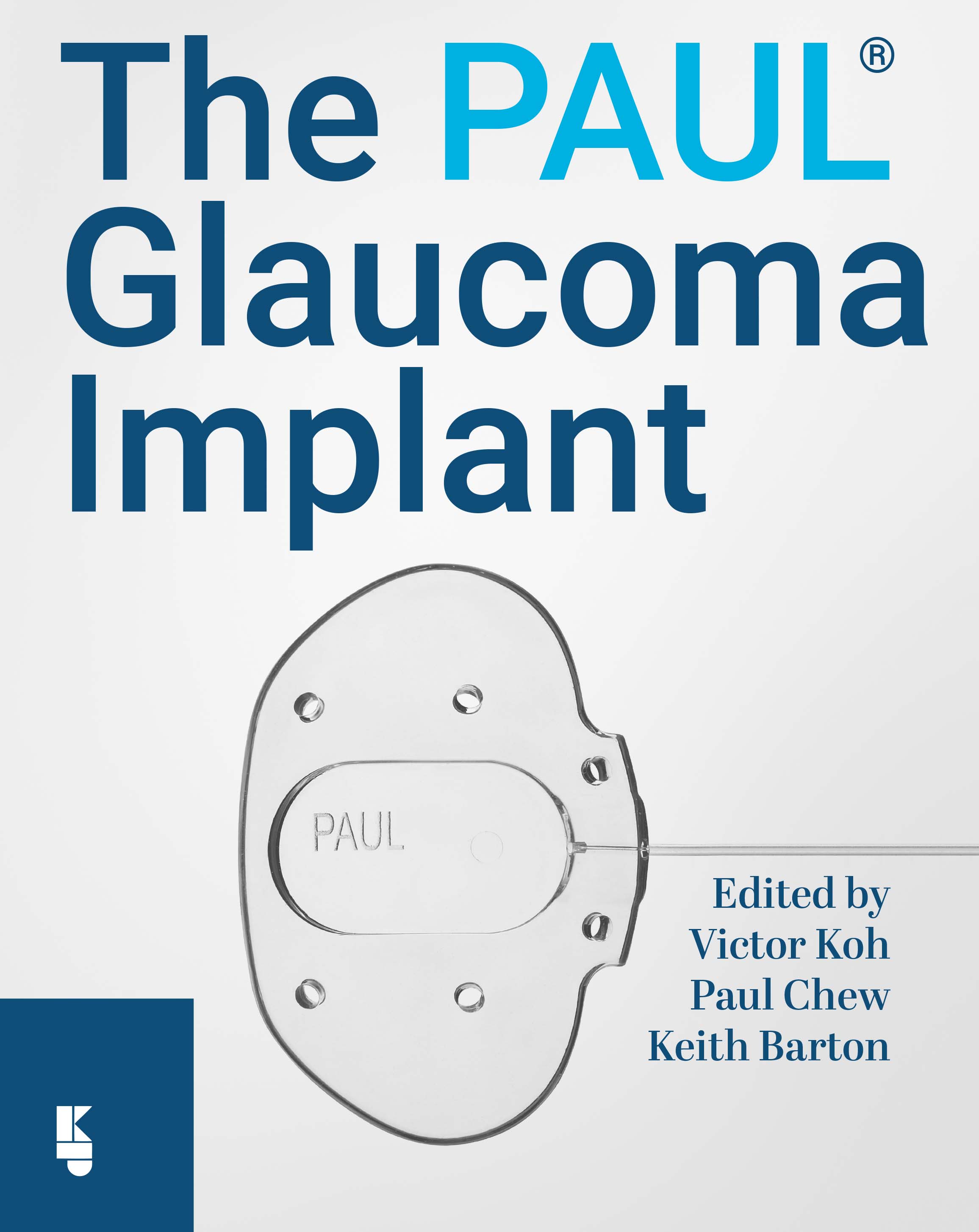
The PAUL Glaucoma Implant
edited by Victor Koh | Paul Chew | Keith Barton
Hypotony in glaucoma drainage devices: prevention and management
Controlling aqueous outflow during glaucoma drainage device (GDD) surgery is critical to minimise early postoperative hypotony, a common and serious complication particularly associated with valveless implants such as the Baerveldt Glaucoma Implant (BGI). The PAUL® Glaucoma Implant (PGI), introduced in 2018, was specifically designed to address these challenges by featuring a smaller tube lumen diameter to limit aqueous outflow. Early clinical data demonstrate that the PGI achieves effective intraocular pressure (IOP) reduction while maintaining a low rate of hypotony-related complications. To mitigate hypotony risk, several surgical techniques have been developed. The intraluminal suture (“ripcord”) technique is currently the most widely employed with the PGI. It involves placing a Prolene thread within the drainage tube to partially obstruct flow, allowing controlled postoperative adjustment via slit-lamp removal without additional surgery. Studies have shown that this technique offers superior IOP stability compared to external ligation and reduces the incidence of early hypotony. External ligation, another preventive method, involves placing an absorbable or removable suture around the external portion of the tube to restrict outflow temporarily. However, its application in PGI surgery is limited by the thinness of the PGI tube, which complicates manoeuvres such as creating Sherwood
@incollection{pgi12mercieca,
  author    = {Mercieca, Karl and Liegl, Constance and Stalmans, Ingeborg and Abegão Pinto, Luís},
  title     = {Hypotony in glaucoma drainage devices: prevention and management},
  booktitle = {The PAUL Glaucoma Implant},
  editor    = {Koh, Victor and Chew, Paul and Barton, Keith},
  publisher = {Kugler Publications},
  address   = {Amsterdam},
  year      = {2026},
  pages     = {99-109},
  isbn      = {978-90-6299-335-2}
}