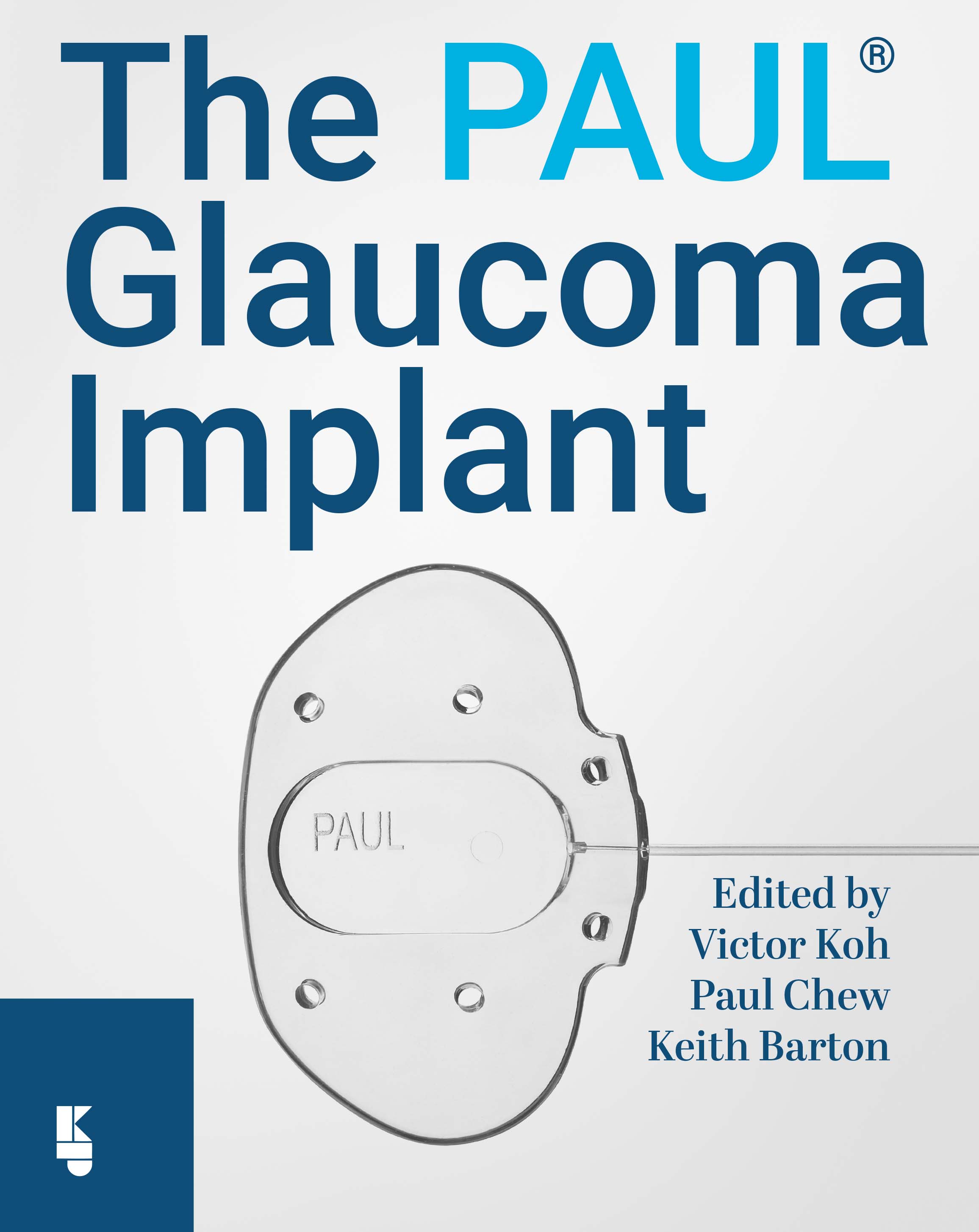
The PAUL Glaucoma Implant
edited by Victor Koh | Paul Chew | Keith Barton
Design optimisation of the PAUL Glaucoma Implant
The PAUL® Glaucoma Implant (PGI) is a novel innovation in the development of glaucoma drainage devices, aiming to improve surgical outcomes and reduce complications associated with conventional tube shunts. This chapter outlines the design optimisation process of the PGI, comparing its structural and functional characteristics with alternatives, including the Baerveldt Glaucoma Implant (BGI) and Ahmed Glaucoma Valve (AGV). The PGI features a smaller external tube calibre (0.457 mm), which aims to lower the risk of conjunctival erosion. Its compact size, combined with precise tube placement, may help prevent corneal endothelial cells loss. The internal tube diameter (0.127 mm) increases resistance to aqueous outflow, theoretically reducing early postoperative hypotony. Additionally, the PGI’s plate design (342.1 mm²) features a shorter wingspan than the BGI but extends further posteriorly, optimising the effective drainage surface area. Studies suggest that the PGI forms larger, more effective blebs than the AGV and BGI, leading to improved long-term IOP control while reducing the risks of bleb encapsulation. These design improvements make the PGI a strong alternative to other glaucoma drainage implants, providing a well-balanced combination of effectiveness, safety, and adaptability to different surgical situations The scope of this chapter is to outline the design optimization process of the PAUL Glaucoma Implant (Advanced Ophthalmic Innovations, Singapore) and
@incollection{pgi4feng,
  author    = {Feng, Kathy Ming and Koh, Victor},
  title     = {Design optimisation of the PAUL Glaucoma Implant},
  booktitle = {The PAUL Glaucoma Implant},
  editor    = {Koh, Victor and Chew, Paul and Barton, Keith},
  publisher = {Kugler Publications},
  address   = {Amsterdam},
  year      = {2026},
  pages     = {35-41},
  isbn      = {978-90-6299-335-2}
}